| Paradox of plus of sum of dynamic value.
Let’s consider transaction between A and B. (Fig.12). Selling and buying
is done at a price of ¥100 in (1). Dynamic value is described under
that. It is followed by reverse of selling and buying transaction. Dynamic
value is described under that. Sum of dynamic value of both A and B after
(1) and (2) is ¥0.
Plus dynamic value is status to have right to receive static value, and
minus dynamic value is status under obligation to offer static value to
others. Therefore, it is economic principle that sum of dynamic value is
0.
|
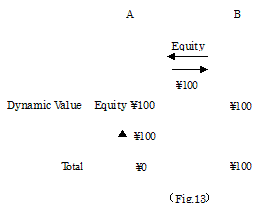
It is assumed that (1)(2) in (Fig.12) is repeated. As B has value of ¥100
after (2), B goes public and A buys stock in B at a price of ¥100.
As a result, sum of dynamic value of A is ¥0, and sum of dynamic value
of B is ¥100. Sum of dynamic value of both A and B is ¥100.
It is economic principle that sum of dynamic value is ¥0. If sum of dynamic value is plus, dynamic value without need to pay occurs. As a result of going public, credit of ¥100 occurs without debtor in (Fig.13).
Money and equity is thought to be dynamic value. Status of plus money (credit) and status of minus money (debt) occur at the same time. If there is only debtee without debtor, it can happen that nothing can be bought with money because no one needs to pay. |
Therefore, it is economic principle that sum of dynamic value (equity,
money) is ¥0. Otherwise credit without debtor occurs.
As described above, credit of ¥100 without debtor occurs in (Fig.13). Equity is double possession of value of money. Dynamic value of equity of ¥100 is over possessed. As just described, sum of dynamic value comes to plus by going public. It doesn’t mean affluence in society. It is only over possession of dynamic value.
In addition, that sum of dynamic value is ¥0 does not mean that buildings,
machines etc. have no value. Equity is thought to be dynamic value. (It
can be exchanged with money in the market.). Sum of money is ¥0 in
principle. Therefore sum of dynamic value must be ¥0.
Naturally, value of buildings, machines etc. which is not supposed to be changed with money (with others) is not ¥0. But these are static values. Dynamic value is asset which can be changed with static value of others.
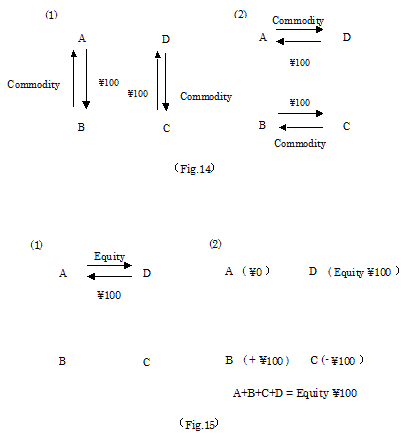
Let’s consider transaction among 4 companies of A, B, C, D. (Fig.14). Transaction
(1) and transaction (2) are conducted alternately. In both (1) and (2),
sum of money of 4 companies is ¥0. (As money of company which receives
commodity earlier is -¥100.)
(Fig.14) After (1), company A issues shares at a price of ¥100 and
company D buys these. (Fig.15) (2) shows dynamic values of 4 companies.
Sum of dynamic value of 4 companies is ¥100. Sum of dynamic value is
plus as much as issued shares.
|