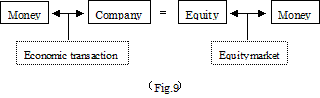
Left : Value of money of others = Economic value of company
(Transactions of buildings etc.
are included.)
Right : Value of money of others = Value of equity
(= economic value of company)
(Fig.9) Economic value of a company is possessed as value of money in economic
transaction and as value of money in equity market. One static value corresponds
to two dynamic values (money of others, equity). Economic value of a company
is possessed doubly.
Source of value of money (for the most part) is listed company. Value of money does not occur without these companies. Economic value of listed company is possessed as money. If value of listed company is possessed as equity in addition, economic value is doubly possessed.
Without Japanese company, nothing can be bought in yen (value of yen is
lost). Source of value of yen is in Japanese company. (Supplier of commodity,
service, etc. (static value)). Economic value of company is possessed as
money of others used in economic transaction. If economic value of equity
is possessed, economic value of company is possessed doubly. (Two dynamic
value correspond to one company (static value)).
Present equity market is established by double estimation of economic value
of company.
Source of dynamic value is static value of others. (Money does not have
value in itself. Source of value is commodity or service supplied by others).
(For the most part) Source of value of money (yen) owned by someone are
commodity or service supplied by Japanese listed company. Without these
supplies, source of value of money is lost, and situation is like to have
fake bill. Dynamic value corresponds to listed company (static value) is
possessed as money of others used in economic transaction.
You can see for all of these reasons described above, possession of such
dynamic value as equity other than money of others used in economic transaction
makes double possession of dynamic value (value of money).
'As equity has management right, it has value independent of money.' This is mistaken notion. Company can supply commodity and service because the company has manager. Value of company which includes management right is possessed as value of money (of others) used in economic transaction.
When business begins to pick up and economic growth rate increases, stock
rises in price. It is to view economic growth (increase of sum of money)
from a different standpoint. Dynamic value of stock is only double possession
of value of money in economic transaction.
(Right in fig.9) Value of equity is possessed as copy of value of money
in economic transaction (Left in fig.9).
So, it is natural for price of equity to rise as scale of economy expands.
As the number of those who cash in the equities increases, the equity market
decline. Equity becomes unsellable in extreme cases.
It is not true that dynamic value of equity is lost by decline in the equity
market. Equity is double possession of value of money and equity does not
have dynamic value independent of money of others in economic transaction.
It is understood that decline in the equity market is realization of this
theory.
Closing price of the Nikkei Stock Average (2008/10/23) is 8,460 yen, total market value of the first section of the Tokyo Stock Exchange is 282 trillion yen. But proper total market value (total dynamic value) is 0 yen. As a result of double possession of value of money caused by paradox of financial economic theory, dynamic value which does not exist essentially is possessed as 282 trillion yen.
Equity transaction is only money transfer among the affected parties. Equity
transaction is only money transfer with confirmation of value of company
(Economic scale etc.). It is reality of equity transaction.
Enormous manpower is spent on useless work. It leads to much better productivity
of all society to abolish going public. People of all society will become
rich.
|