| Economic value of company is possessed as money of others.
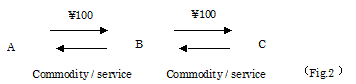
Deal between A and B is made at the beginning in figure 2. As a result,
B has 100 yen (Debtee). A has minus 100 yen (Debtor).
Value of Commodity offered by B to A diminishes with time. So, if B keeps
money, part of the money has no value (no purchase).
After that, B buys
commodity from C. As a result, B has 0 yen and C has 100 yen (Debtee).
At this time, value of 100 yen of C is commodity bought by A and B. But
the commodity value diminishes with time.
After that, deal between A and
C is made (A is debtor of 100 yen and C is debtee of 100 yen). If A is
asked for a discount of service or commodity below 100 yen by C, A can’t
pay debts forever. As A is in debt of 100 yen, A has to pay interest to
C. As notion of option doesn’t introduced to money, economic system is
advantageous to debtee. (Unfair system)
|
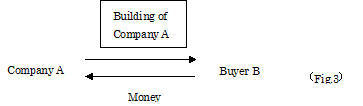
(Fig.3) Economic value of building owned by company A occurs when B buys
it for money.
Before that, economic value of building is possessed by B as money of B.
A owns static value of building.
As described above, economic value occurs by execution of option (of money)
of buyer.
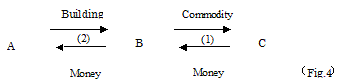
(Fig.4) It is assumed that deal between B and C is made before the building
deal.
Discard option right of C ---- (1)
Discard option right of B ---- (2)
Economic value owned by A occurs as a result of (1) (2) (continuity of economic transaction)
Economic value owned by A is duplicate of economic value of dynamic value
owned by B, and dynamic value owned by B is duplicate of dynamic value
owned by C.
The earlier option owned by B or C is executed, the earlier economic value
owned by A is realized (more certainly).
Economic value owned by A is possessed as money of C (then, of B). So,
to possess it as equity (as dynamic value (equivalent to money)) is wrong.
|