| Difference between interest rate and economic growth rate
As described earlier in sample transaction, it may be understood that interest rate and economic growth rate agree. If these are different, what is happened?
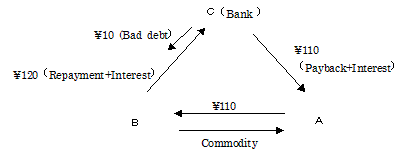
Suppose interest rate on a loan is changed to 20 % and transaction price
is changed to ¥110 (Interest rate of deposit is 10%) in earlier second
transaction. Economic growth rate is 10% in this case. Then B has to repay
¥120 in debt with sales of ¥110. But the amount of difference of ¥10 can’t
be paid. This ¥10 is credit obligation of bank C. The credit obligation
can’t be collected, so it is called bad debt.
|
| As described above, if interest rate on loans of banks is over economic
growth rate, bad debt is sure to occur in proportion to the difference
of rates.
As economic growth rate is number count of the whole country, accurate
meaning is [Bad debt occurs on an average of the whole country.]
As there is no money to repay, it can’t be repaid.
Company of sound financial strength may be tolerant as a matter of course,
but company of needy financial situation may have bad debt - be in bankruptcy.
Therefore, it is necessary to keep consistency between interest rate and
economic growth rate in order to prevent occurrence of bad debt.
As discussed above, mechanism of occurrence of bad debt may be grasped.
Nominal economic growth rate has been turned to minus, but loan rates in
banks have been plus since the year 1998. As there is no money to repay
the difference, it becomes obvious as bad debt.
Therefore, no matter how hard banks clear away bad debts, bad debts increase under the condition of minus economic growth rate. It is theoretically inevitable conclusion.
In addition, the reason for companies to have poor intention to borrow money although the Bank of Japan realizes zero interest policy can easily be understood. To borrow money has high possibility to lose under the condition of minus economic growth rate and plus loan rate. Possibility to lose is higher than possibility to gain on an average.
Therefore, it is necessary to introduce interest rate [minus interest
rate] that fits economic situation for companies to enhance the willingness
to invent, and to stimulate the economy.
There may be opinion that interest rate should be plus and original principal should be guaranteed from the viewpoint of depositor protection, but it is impossible naturally. Currency exists with economy. If economy diminishes, currency decreases inevitably. If currency doesn’t decrease, depositors have currency that doesn’t exist essestially. If this type of currency increases, credit across whole economy is lost. Therefore, it is necessary to introduce minus interest rate when economy diminishes.
In addition, as interest rate over economic growth rate is excessive repayment
burden, companies may be in bankruptcy. Then economic value over interest
burden is lost. As a whole nation, demerit of company’s bankruptcy is far
more than merit of depositor’s interest received. In short, interest rate
over economic growth rate destroys the economy.
Therefore interest rate should usually be controlled to burden both debtees
and debtors equally. The interest rate is economic growth rate. Is it OK
with you?
|